

In the summer of 2025, forest conservation and improvement work began in the black pine forests of the Pyrenees. These actions include a set of measures aimed at enhancing and preserving this high‑mountain habitat, classified by the EU as a priority habitat of community interest, with Catalonia hosting the largest representation in all of Europe.
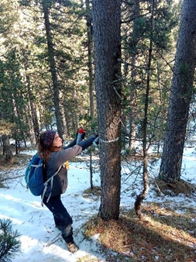
The planned forest interventions will cover more than 300 hectares of forest, using two complementary management approaches with different objectives. On one hand, in certain forest stands, the project promotes the implementation of multifunctional forest management based on the principles of close‑to‑nature silviculture, integrating key elements for biodiversity conservation and enhancement. “The multifunctional approach aims to balance the two main objectives of the forest stand (production and biodiversity conservation), while close‑to‑nature silviculture was chosen for the project due to its high precision and efficiency, and because it allows for a careful integration of biodiversity‑enhancing criteria. This management model applies selective thinning with individual tree marking, relying on the ecosystem’s natural dynamics, fostering continuous natural regeneration, structural and species diversity, and soil fertility, while maintaining canopy cover and producing commercial timber. This results in a more diverse, vigorous, and resilient forest in the face of biotic or abiotic stress.” Work has already begun in the counties of Alt Urgell, Cerdanya, and Berguedà, where nearly 40 hectares have been treated. During autumn 2025, interventions also started in Ripollès, Pallars Jussà, and Pallars Sobirà.
The second management approach launched this summer focuses on improving habitat conditions in stands designated for free evolution. In these areas, forests were selected because they already show an acceptable conservation status and are beginning to exhibit features typical of mature forests, such as very large and/or old trees or large deadwood both standing and on the ground. These elements create small gaps that promote natural regeneration and increase the forest’s structural heterogeneity. These forests have a higher capacity to host biodiversity, although they are currently very scarce.
The planned actions aim to increase these maturity attributes, preparing the forest dynamics for free evolution—meaning no future silvicultural intervention—according to the agreements signed for a 25‑year period.
The project works on both public and private lands through voluntary agreements with landowners and has a strong demonstrative character. Although the intervention area is relatively small, it will provide highly valuable information to help scale the management model to the entire habitat. For this reason, significant effort has been invested in monitoring the interventions and their ecological impact.